
1. What are the opportunities for ADC Analytical Development at the moment?
The opportunity right now is depth — not just breadth.
We've moved beyond first-generation ADCs. Now we're working with dual payloads, bispecific formats, high-DAR species, and complex linker chemistry. That complexity calls for analytical development to take on a strategic role rather than just a support role.
DAR distribution, off-target conjugation, free linker species, and payload degradation pathways are no longer just analytical observations. They directly impact regulatory confidence and clinical risk. The teams that succeed are those that incorporate physicochemical characterization, bioassay strategy, and impurity control into a unified control strategy from IND onward.
2. How has this space evolved recently?
A few years ago, the discussion focused on average DAR and basic potency assays. Now, the expectations are significantly different.
We're discussing comprehensive DAR distribution, orthogonal techniques — native MS, 2D-LC/MS, CE — advanced charge variant profiling, and mechanistic potency models that accurately represent biological complexity. Agencies are also raising sharper questions about phase-appropriate justification, comparability, and impurity risk for new modalities.
But what's changed the most isn't the instrumentation — it's the mindset. Analytical development is no longer just about generating data. It's about building a defensible scientific narrative that connects structure, function, and patient risk.
3. What are the most promising analytical techniques in the space at the moment?
Native mass spectrometry and advanced LC-MS platforms are transforming how we understand DAR distribution and off-target conjugation. 2D-LC/MS for charge variant analysis provides molecular-level insights that weren't accessible before. High-resolution MS combined with NMR is becoming essential for analyzing payload degradation and impurity elucidation.
On the bioassay side, mechanism-driven potency models — especially for bispecifics and dual-payload ADCs — are shifting from optional to essential.
The true promise isn't just one technique. It's the smart combination of different methods into a unified regulatory system. That's what sets it apart.
4. What exciting work are you looking forward to sharing at the summit?
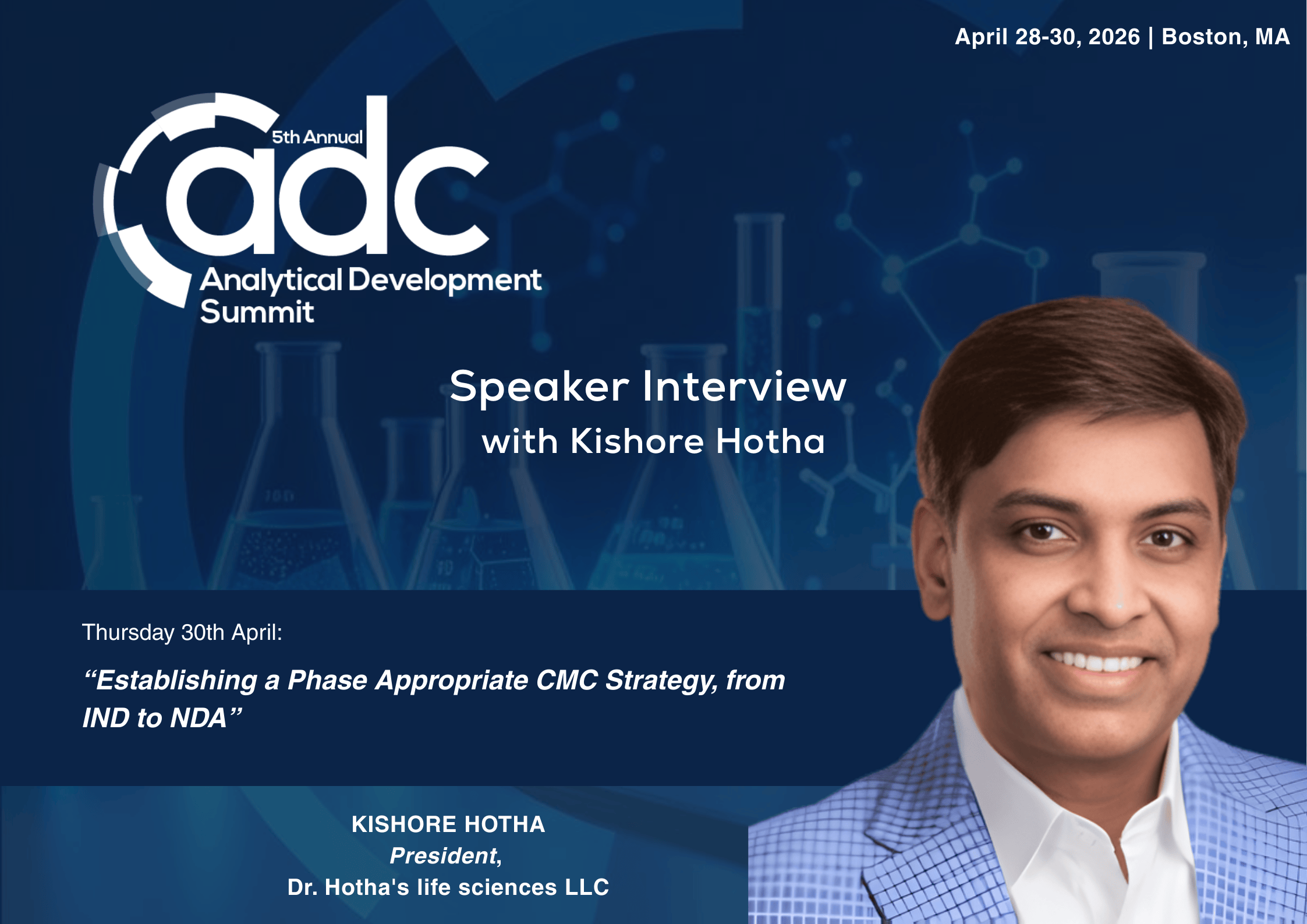
I'll be presenting on two interconnected topics: the phase-appropriate CMC strategy from IND to NDA, and the rigorous definition of ADC-specific critical quality attributes.
These can't be separated. CQAs are the scientific foundation on which your entire CMC strategy is built. How you define and justify DAR distribution, free linker species, payload degradation, and off-target conjugation directly influences your control strategy and your regulatory filing at every phase gate.
The programs that succeed are those where CQA selection is proactive and backed by science — not reactive. That's the mindset I intend to bring.
5. What are you looking forward to at the 5th ADC Analytical Development Summit?
This summit occupies a unique space. It brings together analytical scientists, CMC leaders, QC experts, and regulatory thinkers in one technically focused forum — and that combination matters.
This year, the agenda focuses on addressing heterogeneity, bioassay design, and comparability, making it especially timely. But more than any single session, I look forward to the honest conversations between sessions. For a field moving as fast as ADC development, those are often the places where practical solutions emerge.

Explore the Agenda
Gain actionable insights from expert-led sessions on advanced DAR analysis, next-gen bioassays, and impurity control

Partner With Us
Connect with 80+ ADC analytical leaders actively seeking critical analytical method development and outsourcing challenges

Join ADC Analytical Experts
Network with senior scientists and decision makers from top ADC biopharma during dedicated sessions designed to build key collaborations